
Author Dr. Michael A. Scordato, Ph.D. utilizing the past notes and scribbles used from actual counseling sessions.
Why should we care? Why read the Bible at all? What difference does it actually make? Those are fair questions—especially in a world that never seems to slow down. Everything changes. Life moves quickly. Things we thought would last…don’t. As Scripture puts it, “The grass withers, the flower fades” (Isaiah 40:8). You don’t have to look far to see that’s true. And honestly, that can leave people feeling a little unsteady. Like there’s nothing solid to hold onto. But the Bible points us to something different. It says there is something that doesn’t change—something steady in the middle of all the shifting. Jesus said it this way: “Heaven and earth will pass away, but my words will not pass away” (Matthew 24:35). That’s a bold claim. And it’s repeated again and again throughout Scripture.
We are going to look at the Bible as a whole today. But to prep for this we have to grasp some key concepts and whole ‘forest’ sized thoughts!
The Story’s Skeleton:
1-The Beginning
2-The Hebrew Fathers
3-The Exodus
4-The Promised Land
5-The Judges
6-The Kingdom
7-The Exile
8-The Restoration
9-The Pause
10-The Coming of Christ
11-The Great Commission
12-The Conclusion
PART ZERO: The Executable Reason
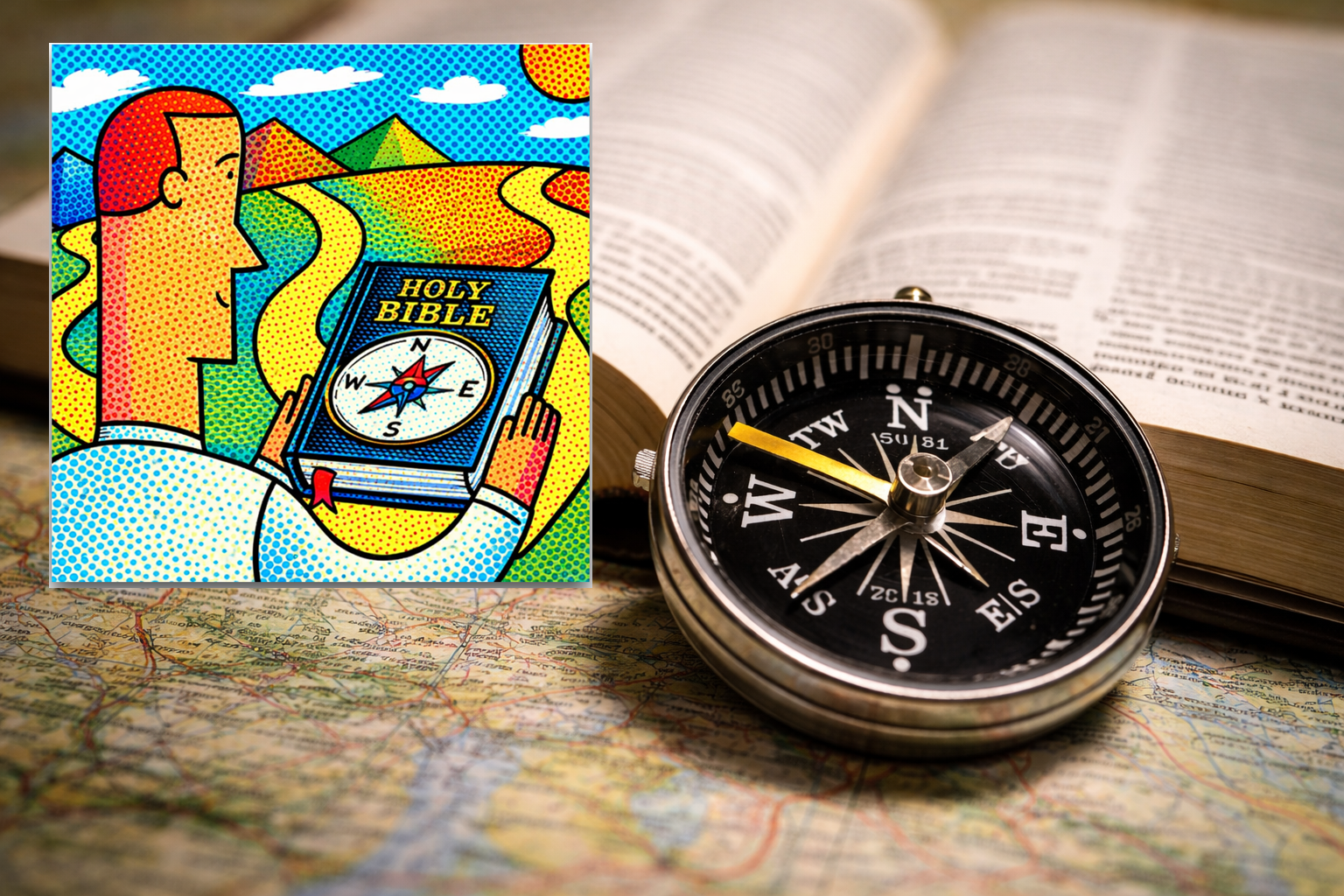
Just as the compass always points toward the north, so the Bible ultimately points toward Jesus.
God’s Word doesn’t fade with time. It doesn’t lose its meaning. It doesn’t become outdated. It stands. “Forever, O Lord, Your word is settled in heaven” (Psalm 119:89). “The word of the Lord endures forever” (1 Peter 1:25). And God promises that what He says will do something—it won’t come back empty (Isaiah 55:11). That means when you open the Bible, you’re not just reading old words on a page. You’re stepping into something living and reliable—something you can actually build your life on. And that matters. Because life is complicated. It’s unpredictable. And at times, it’s hard. But if there really is something unchanging—something true no matter what—then it’s worth paying attention to.
God has, through both His physical and or miraculous means, been preserving this Bible we have for us so we will not have a generation without it. Do not believe those who state otherwise, the Bible did not go missing for years. We have it here in front of us yesterday, today, and forever more. This is how certain God works. 1 Peter 1:25, “But the word of the Lord endures forever. Now this is the word which by the gospel was preached to you.”
We all go through seasons of uncertainty. Life can feel overwhelming, confusing, and at times just plain hard. In those moments, the idea that God is present—and still in control—can bring a deep sense of peace. The Bible doesn’t describe God as distant or uninvolved. It paints a very different picture. Again and again, we’re shown a God who is close, attentive, and actively caring for His people. And when you start to see that, it can really change how you face life.
Scripture speaks often about how personal that relationship can be. In Isaiah 49:16, God says, “See, I have inscribed you on the palms of My hands.” That’s a powerful image. It means you’re not forgotten. Not overlooked. You matter enough to be remembered constantly. And it goes even further. Isaiah 41:13 says, “For I, the Lord your God, will hold your right hand… Fear not, I will help you.” That’s not the picture of a distant God. That’s a God who steps in—who guides, supports, and stays with you, even when things feel uncertain. He doesn’t just watch from a distance. He walks with you.
Jesus makes this idea of security very clear in John 10:28–29. He says, “I give them eternal life, and they shall never perish; neither shall anyone snatch them out of My hand…” and then reminds us that no one can take them out of the Father’s hand either.
Think about what that means. If you belong to Him, you’re not barely holding on—you’re being held. And not just by anyone, but by God Himself. Nothing is stronger than that. Nothing can pull you away from His grip. That kind of promise isn’t just comforting—it changes how you live. It gives you a quiet confidence, knowing your future isn’t fragile or uncertain.
But God’s care isn’t only about eternity. God leads us right now, in the middle of everyday life. Psalm 139:10 says, “Even there Your hand shall lead me, and Your right hand shall hold me.” No matter where you are or what you’re going through, God is still leading. Still present. Still constant. This means whether life is going well or falling apart, God’s presence doesn’t disappear. He guides. He steadies. And Psalm 31:15 says, “My times are in Your hand.” That’s a simple statement, but it carries a lot of weight. It means your life isn’t random. It isn’t out of control. It’s in His hands. And that’s enough.
But it doesn’t stop at protection. The Bible also teaches that God is in control—not just of parts of life, but of all of it. Romans 8:28 puts it this way: “All things work together for good to those who love God, to those who are called according to His purpose.” That’s one of those verses people hold onto, especially when life doesn’t make sense. It reminds us that even in the middle of difficulty, God is still at work. That doesn’t mean everything feels good in the moment. Some things are genuinely painful. But it does mean those things aren’t wasted.
Genesis 50:20 shows this clearly. What others meant for harm, God was able to turn into something good—to bring about a greater purpose “saving many”. That’s a powerful idea. It means even the worst moments in life aren’t outside of God’s reach. And honestly, we don’t always understand how He does that. But Scripture keeps pointing us back to the same truth: God’s purposes are bigger than what we can see. Verses like “He does according to His will in the army of heaven And among the inhabitants of the earth. No one can restrain His hand Or say to Him, ‘What have You done?'” In Daniel 4:35 remind us that no one can stop His will or question His authority. And Isaiah 46:10-11, “…My counsel shall stand, And I will do all My pleasure…” says that what God plans, He carries out. In other words, He’s not guessing. He’s not reacting. He’s in control. And that truth isn’t meant to make us feel small—it’s meant to give us peace. Because if God really is in control, then our lives aren’t random or meaningless. Our lives have Ephesians 2:10 purpose. They’re held, guided, and shaped by Someone who knows exactly what He’s doing.
At its core, the Bible is a message of hope. It reminds us that God is in control—and that we are held securely in His hands. When you start to really take that in, it changes things. You begin to see His love not as distant, but steady. His care isn’t occasional—it’s constant. And His power isn’t abstract—it’s personal. So as you move through life—with all its ups and downs—these truths can become something you lean on. Something that gives you strength when you’re tired, and confidence when you’re unsure. Because in the end, your life isn’t hanging by a thread. It’s held in His hands. But there’s something even deeper running through all of this.
PART ONE: Protevangelium
From beginning to end, the Bible tells one unified story. It’s not just a collection of verses or ideas—it’s a connected message. A thread that runs from the very first pages all the way to the cross, and beyond. Some people call it the “scarlet thread of redemption.” You see hints of it right away. Even in Genesis. After the fall, when everything seemed broken, God made a promise. In Genesis 3:15, He said to the serpent: “And I will put enmity between you and the woman, and between your seed and her Seed; He shall bruise your head, and you shall bruise His heel.” It’s a difficult verse at first glance. But it points forward—to a coming victory. A promise that evil wouldn’t have the final word. And that promise is what ties the whole Bible together.
This moment in Genesis 3:15 is often called the Protevangelium—the first glimpse of the Gospel, the first piece of good news that restoration with God is coming.
And that matters, because everything we’ve talked about—security, guidance, God’s control—flows out of this one promise. God’s Word endures because His plan to redeem people endures. Right there in Genesis 3:15, something unusual is said. The promise speaks of the “seed” of the woman. That’s not how lineage is normally described. It points forward to something specific—a coming Savior, born in a way that would stand apart…a virgin birth since women do not have seed, men do. Christians understand this as pointing to the Messiah, Jesus – ‘’the Anointed One’. “Christ” is the Koine Greek way of saying Hebrew “Messiah” meaning even the word “Christian” comes from this idea—it means being identified with, or belonging to, the Messiah. And yes, that’s a claim not everyone agrees with. But it’s central to understanding what the Bible is actually saying. John 1:41, “…He first found his own brother Simon, and said to him, ‘We have found the Messiah’ (which is translated, the Christ)”.
One of the clearest pictures of this promise unfolding is found in Isaiah 53. Written hundreds of years before the cross, it describes a suffering Servant who would absorb the full weight of humanity’s brokenness with striking detail. “But He was wounded for our transgressions, He was bruised for our iniquities… and by His stripes we are healed.” (Isaiah 53:5) When you read the rest of Scripture through that lens, everything starts to connect.
“I have inscribed you on the palms of My hands” (Isaiah 49:16) — Those hands would one day be pierced, making that image even more powerful and personal.
“Fear not, I will help you” (Isaiah 41:13) — God’s help wasn’t distant. He stepped into suffering Himself.
“No one shall snatch them out of My hand” (John 10:28–29) — That security came at a cost. The Good Shepherd laid down His life for the sheep.
“All things work together for good” (Romans 8:28) — The cross is the ultimate example: what looked like defeat became the greatest victory.
“You meant evil against me, but God meant it for good” (Genesis 50:20) — Even earlier stories, like Joseph’s, begin to point forward to this same pattern—God bringing good out of what was meant for harm.
When you start to see it, it’s hard to miss. The Bible isn’t a collection of disconnected ideas. It’s one story—moving toward redemption, centered on a promise, and fulfilled in a Person.
PART TWO: The Causation’s Causation
But let’s be honest for a moment—does any of this actually make a difference in real life? Or is it just theory? The Bible’s answer is that it absolutely makes a difference. Because everything it says is rooted in who God is—our Creator. Go all the way back to the very first verse: Genesis 1:1 — “In the beginning God created the heavens and the earth.” It’s a simple sentence. But it carries a lot more than it seems at first.
“In the beginning” — that’s the creation of time. “The heavens” — that’s the creation of space. “And the earth” — that’s the creation of matter.
Science Moment: Math, logic, and also the mind can and do exist outside of these three aspect dimensions. All Greater Nature came together happening at one time as all time was happening at once originally as shown, until God created time and slowed things down to be enjoyable for us. This Greater Nature is God whom created the nature we observe and see. He is called the Uncaused First Cause. Isaiah 45:5, “I am the Lord, and there is no other; There is no God besides Me…” Isaiah 44:8, 46:9, and Exodus 20:3, establish a strict monotheism. There simply are no other God’s but God. Only one Greater Nature.
In other words, everything we experience—everything science studies—has its origin here. Time, space, and matter all begin with God. That means God isn’t part of the universe. He isn’t limited by it. He exists before it, outside of it, and over it. He’s not just another force within nature. He’s the One behind it. And once you start to see that, something clicks. If God has the power to create everything—just by speaking—then the promises He ‘SAYS’ which we’ve been reading about aren’t small claims. They’re backed by that same power. They’re not wishful thinking. They come from the One who made everything in the first place leaving His Romans 1:20 signature and fingerprints all over.
Morality, laws of logic, uniformity in nature, man’s religious nature (desire to know or make God – you do not see squirrels having or conducting religious services), even man’s repulsion of the One True God that differs from the one he wants, historic evidence backed by scientific evidence make even great thinkers who studied the universe deeply recognized that something—or Someone—of intelligence must be behind it all. Albert Einstein, for example, spoke about the Intelligent Design awareness in a sense of awe of the order in the universe pointing beyond itself. But there’s an important distinction here. Recognizing that God exists is not the same as knowing Him.
PART THREE: Relationship Over Just Being Religious And Nerdy
You can understand the structure of the universe… and still miss the relationship God is offering. And that’s where the Bible brings everything together. Because the same God who created time, space, and matter is the same God who made promises, who stepped into history, and who invites us to know Him personally. So when you read about His power—His guidance, His protection, His plan—it’s not abstract. It’s grounded in who He is. And that changes everything.
2 Timothy 1:7 says, “For God has not given us a spirit of fear, but of power and of love and of a sound mind.” That’s not just a nice, comforting line. It’s a serious statement. The “power” mentioned here isn’t vague or emotional—it comes from the same God who created everything. The One who set the universe in motion is the One who gives His Spirit to those who belong to Him. And when you really think about that, it changes how you look at fear. If that’s the source—if that’s where your strength comes from—then fear starts to lose its grip. The power spoken of here originates from the same God who engineered the cosmos. The One who flung galaxies into position and set the physical laws of the universe into motion has deposited His Spirit — carrying that same divine capability — within every believer. Fear, then, becomes illogical in the face of such a Source.
Philippians 4:13 builds on that idea: “I can do all things through Christ who strengthens me.” That doesn’t mean we suddenly become unstoppable on our own. It means we’re not relying on our own strength anymore. The word strengthens here carries the idea of being infused with divine enabling (filled up and supplied). Paul was not speaking of human willpower or optimistic self-confidence. He was speaking of drawing upon the same limitless power that Genesis 1:1 reveals — the power of the Creator Himself flowing through a surrendered life. And that same idea shows up in Ephesians 6.
Ephesians 6:10-18 instructs believers to put on the full armor of God — and this instruction carries far greater weight when understood through the lens of Genesis 1:1. Every piece of that armor — pants and utility held up and on by Proverbs 23:23 truth, Proverbs 11:4 righteousness protecting your major organs and heart, the gospel of peace James 2:26 applied becomes a protection guard on your life’s stance, a defensive block and bashing Matthew 17:20 power of faith, with a mind saving Matthew 16:26 brain preserving salvation, using the slicing Hebrews 4:12 two-edged cuts of the Word of God as attacks, all bound together through a life of continual 1 Thessalonians 5:17 prayer— is not merely symbolic equipment. It is the character and nature of the Creator Himself applied as a covering over human frailty. The God who created all matter now clothes His people in something infinitely stronger than matter itself — His own divine attributes. This is the logical and theological foundation that makes the armor not merely helpful, but invincible in eternal terms.
Truth, righteousness, faith, salvation, the Word of God—these aren’t just concepts. They reflect who God is. And when we “put them on,” we’re not just trying harder—we’re leaning into His character, His strength, His way of living. It’s not about becoming stronger on our own. It’s about being covered by something stronger than we are. And maybe no verse brings all of this together more clearly than Zechariah 4:6: “Not by might nor by power, but by My Spirit,” says the Lord of hosts. That was spoken to Zerubbabel, who had the overwhelming task of rebuilding the temple. From a human perspective, it was too much—too many obstacles, not enough resources. God’s answer wasn’t to give him more tools, more people, or a better strategy. It was simple: My Spirit is enough. And that same truth still applies. The God who created everything without effort is not limited by the challenges we face. He doesn’t run out of strength. The logic is airtight: If God created everything from nothing, then no obstacle we face is beyond His capability.
If His Spirit accomplished creation itself, then no temple, no calling, no act of obedience is too great for that same Spirit to complete through us. Human might and human power are not the variables that determine success in God’s kingdom. He doesn’t need ideal circumstances. So the question isn’t whether we have enough ability. It’s whether we’re relying on Him. Because in God’s kingdom, it’s not human strength that makes the difference. It’s His Spirit.
This idea of God as Creator—and the power He gives through His Spirit—doesn’t stand separate from the promise we saw in Genesis 3:15 and Isaiah 53. It actually brings it into sharper focus. Because the same God who has unlimited creative power chose to use that power in a way no one would expect—not through force, but through sacrifice. The Creator became the Suffering Servant. The Lord of hosts became the Lamb led to the slaughter (Isaiah 53:7). The One who spoke time, space, and matter into existence allowed Himself to be wounded (Isaiah 53:5), fulfilling that promise all the way back in Genesis. And He did that so His Spirit—the same Spirit spoken of in Zechariah 4:6—could dwell within those He came to redeem.
So Zechariah 4:6 isn’t just about rebuilding a temple. It shows us something deeper about how God works. It is a window into the very nature of how the Creator God operates in human history — not through overwhelming force, but through the quiet, invincible, sustaining power of His Spirit, working through surrendered and redeemed lives, accomplishing purposes that no human strength could ever achieve. Genesis 1:1 gives us the starting point for everything: “In the beginning, God created the heavens and the earth.” If that’s true—and the Bible builds everything on that truth—then every promise that follows carries real weight.
The strength in 2 Timothy 1:7. The confidence in Philippians 4:13. The armor in Ephesians 6. The dependence on His Spirit in Zechariah 4:6. None of these are abstract ideas. They all come from the same source—the God who created everything. And that means we’re not putting our hope in something distant or theoretical. We’re held by Him. Equipped by Him. Strengthened by Him. Redeemed by Him. The very God who made the universe is the One who knows you, holds you, and chose to make a way for you to be part of His story. And that changes everything.
PART FOUR: The Flow
When you step back and look at it, the message of the Bible follows a clear and powerful progression:
The Problem — The world is broken. Life is uncertain. Things don’t last the way they should. This all traces back to the fall in Genesis 3.
The Promise — Right in that moment, God made a promise. A Redeemer would come—One who would ultimately defeat the enemy (Genesis 3:15).
The Plan — Isaiah 53 shows how that would happen. Not through force, but through suffering. The Redeemer would take our place.
The Proof — This is where everything becomes real. Every promise of security, guidance, and provision is grounded in the cross. God didn’t just say He would hold us—He gave Himself to make it possible seen with the proclamation of John 3:16-17 with a heart to save instead of condemn judgment on.
The Purpose — Because of that, we don’t have to live in uncertainty. We can live with confidence, knowing that what God started, He has already secured through Christ Philippians 4:13 enabled to do all things pertaining to life.
At the end of the day, this isn’t just about encouragement. It’s about who God is. It is about His character and covenant faithfulness. From the first whisper of hope in the Garden to the detailed suffering portrait of Isaiah 53, God was always moving toward one moment: the moment His own Son bore the bruising of Genesis 3:15 so that we could be inscribed on His palms, held in His hand, and eternally secured in His love. The bruising spoken of in Genesis became reality. That is the reason every promise in this study holds. That is why the Word never returns void. The Scarlet Thread runs through it all focusing the Bible into being our Basic Instructions Before Leaving Earth (B. I. B. L. E.) proving that there is a light at the end of the tunnel as 2 Peter 3:12-13 encourages Christians to live holy lives while eagerly anticipating Christ’s return (“looking for and hastening the day of God”).
Jesus’ cry “It is finished!” (John 19:30) is a declaration that His earthly mission of redemption was accomplished. It signifies that the debt of sin was fully paid, Old Testament prophecies were fulfilled, and a final, permanent salvation was achieved, often interpreted through the Koine Greek term tetelestai, meaning “paid in full” The suffering described in Isaiah took place. And through it, a Ephesians 2:8-10 way was made. So when the Bible says we are known, held, and secure in His hands—it’s not just poetic language. It’s something that was paid for. That’s why these promises hold. That’s why God’s Word doesn’t fail. There is a thread running through all of it—a single, consistent story pointing to redemption. And when you start to see that, the Bible stops feeling like a collection of separate parts… and starts reading like one unified message. A message you can trust. A message you can build your life on.
PART FIVE THE DOCTRINAL PATH: Unveiling the Twelve Simple Steps Through the Bible
Original foundation by John Yates (AA, BS, MAR), Director of Faith Bible Institute (FBI), with additional development and emphasis by Dr. Michael A. Scordato, Ph.D.
The world spun. Metal twisted. Wind screamed. Dust filled the air. Elias coughed, the sharp smell of burning fuel catching in his throat. Somehow, he was still alive. But the wreckage of the plane had become his prison, and the wilderness around him felt vast and unforgiving. He reached for a map—his only hope of finding a way out. But it wasn’t whole. It had been torn into pieces. Scattered. Falling apart incomplete. As he tried to put it back together, nothing lined up. Mountains ran into oceans. Rivers stopped midstream. Familiar landmarks were gone. Every attempt felt promising at first… but led nowhere. He couldn’t tell where he was. And he had no idea how to get where he needed to go. The sun began to set, painting the sky in deep oranges and purples. It should have been beautiful. Instead, it felt like a warning. Darkness was coming. Hunger set in. The wind grew colder.And the reality hit him—he wasn’t just physically lost. He was completely disoriented. His situation felt a lot like life can feel sometimes. Pieces everywhere. Nothing connecting. No clear direction forward. And that’s where the Bible speaks.
In Matthew 4:4, Jesus says, “Man shall not live by bread alone, but by every word that proceeds from the mouth of God.” In other words, we don’t just need physical survival—we need direction. Truth. Something that helps us make sense of where we are and where we’re going. The Bible is meant to be that guide. A map for life.
The Problem of Confusion
Here’s where many people get stuck. They open the Bible, start in Genesis, and try to read straight through to Revelation. It seems like the logical approach—but for many, it quickly becomes overwhelming. Not because the Bible is unclear—but because it’s not arranged strictly in chronological order. Instead, it’s grouped by type of writing—history, poetry, prophecy, letters. Without understanding that, it can feel like jumping back and forth in time, losing the bigger picture along the way. That’s where confusion sets in. And often, discouragement follows. But that’s not how it’s meant to be.
Jesus gave a clear mission in Matthew 28:19–20—to go and make disciples. Part of that calling is helping others understand the Bible as a whole, not just in pieces. Because when you begin to see it chronologically, something changes. Events start to connect. Prophecies make sense. People and places fall into context. You begin to see the story unfold—from creation, through history, all the way to Christ and beyond. Instead of a collection of separate books, the Bible becomes one unified, unfolding story.
A story with purpose. A story with direction. A story that speaks into real life. That’s the goal of this study.
To walk through the Bible step by step—chronologically—so the bigger picture becomes clear. To see how it all fits together. And to understand how that story speaks directly into our own lives today.
Reading the Bible chronologically helps you see the big picture. Instead of disconnected pieces, the story begins to unfold as one continuous narrative—from Genesis all the way to Revelation. It helps connect the dots. You start to see how historical events tie directly to spiritual lessons—like David’s life alongside the Psalms, or how prophets (like Isaiah with King Hezekiah) spoke into real situations happening at the time. It also gives context.
When events are read in the order they happened, the “why” behind them becomes clearer. Cultural settings, struggles, and decisions all start to make more sense. And it brings prophecy into focus. Promises made in the Old Testament can be seen clearly fulfilled in the New Testament—especially those pointing to Christ. You begin to see just how consistent and faithful God is. It also helps with the New Testament itself. For example, Paul’s letters make much more sense when you read them alongside the events in Acts as well as what happened before hand in the Gospel or Old Testament sources he quotes. You can see where he was, what he was facing, and why he wrote what he did. Over time, something else becomes clear—God’s character. You see the same God working in different times and situations, but with the same purpose. The Bible starts to feel less like a textbook and more like a lived-out story. In short, it helps answer not just what happened—but why it matters.
The English Bible currently is organized into 9 areas of topical division. Each area having a specific method encouraged how to explore that type of text. OLD TESTAMENT (Old Promise): (1) the Pentateuch 5 books of law [Genesis through Deuteronomy], (2) the 12 books of History [Joshua through Esther], (3) 5 books of Wisdom Literature [Job through Song of Solomon {also called Song of Songs meaning ‘Best Song’}], (4) the 17 books of the Prophets [5 ‘larger books’ called the Major Prophets: Isaiah through Daniel, and 12 ‘smaller books’ called the Minor Prophets: Hosea through Malachi), NEW TESTAMENT (New Promise): (5) the 4 Gospels [Matthew through John] (Matthew 28:1-6, Mark 16:1-7, Luke 24:1-12, and John 20:1-18 IS THE ACTUAL START POINT OF THE NEW TESTAMENT ), (6)History through Acts of the Apostles, (7) the Pauline 13 [Romans through Philemon], (8) General 8 Epistles [Hebrews through Jude, Hebrews being influenced and a recorded work of Paul’s words (the people mentioned are all around Paul as well as the concepts and how they are presented are Pauline in nature) though different penning author. Note that ancient writing close to the timeframe of its’ making claim it is Peter who penned it therefore this may very well have been a tag-team work of Paul and Peter to their homeland’s people…I mean if you look at Peter’s epistles you can see Paul’s characteristic style of writing influencing this fisherman setting him far higher in literacy style than John and even Mark, his Roman Citizen Godson]. (9) the last book of the Bible is the Revelation Of Jesus to John, being Prophecy/Apocalyptic. Revelation is a book of past, current, and future prophecy. In this study, we shall explore the Bible chronologically instead of by these topical or writer divisions. We will do such to show how these areas all are connected together as one whole. But first, know about the Testaments.
In the Bible, the word “testament” means covenant—a sacred agreement. In this case, it refers to the relationship between God and His people. He is Genesis 3:15 coming! The Old Testament focuses on God’s specialized covenant with Israel to accomplish this, established through Moses. It includes the Law, historical accounts, the writings of the prophets, and technically the four Gospels as well since still under the old covenant then, though the Gospels are placed in the New Testament as a launching point of transition. This old covenant revealed God’s standards and showed humanity’s need for a savior, the Genesis 3:15 Messiah, Christ.
The New Testament reveals that there is something more we all seek. It centers on Jesus Christ—His life, His teaching, His sacrifice, and the beginning of the early church, and glows the fact that He is coming back once again. This is affective since the actual New Covenant, New Testament begins at the resurrection since Jesus paid for sins on the cross by canceling the debt of our transgressions, “nailing it to the cross” (Colossians 2:14), 1 Peter 2:24, “bore our sins in His body on the tree,”, and 2 Corinthians 5:21 was made sin for us to provide righteousness. Through Him, a new Genesis 3:15 accomplished covenant is established, fulfilling what the Old Testament had been pointing toward all along.
Jesus describes this moment in Luke 22:20: “This cup is the new covenant in My blood, which is shed for you.” With that, He makes it clear—this new covenant would be established through His sacrifice. Later, Hebrews 8:13 explains the shift: “In that He says, ‘A new covenant,’ He has made the first obsolete…” In other words, the old system—based on the Law—served its purpose. It revealed sin, exposed the need for a Savior, and pointed forward to Christ. But it was never meant to be the final step.
Again it’s very important to understand that the four Gospels (Matthew, Mark, Luke, and John) begin during the time of the Old Covenant. The New Covenant is fully established through Jesus’ death and resurrection. So the Old Testament doesn’t stand apart from the New—it leads into it. It prepares the way. That’s why all of Scripture matters. In Acts 20:27, Paul says, “I have not shunned to declare to you the whole counsel of God.” And in 2 Timothy 3:16–17, we’re reminded that “all Scripture is given by inspiration of God… and is profitable.” That includes both Old and New Testaments. Together, they form one complete message—teaching truth, correcting error, and guiding us toward a life that reflects God’s purpose. And when you begin to step back and see it as a whole, something starts to come into focus. Not just individual stories—but one unified picture. Like stepping back and finally seeing the entire map instead of scattered pieces. And that’s exactly what this study is about. So the question is: Are you ready to start putting the pieces together?
Case Story: More Than I Thought I Was Getting
Doctrine Illustrated: Progressive Revelation, Illumination, and the Fullness of Special Revelation
Background
Kezia had given her life to Christ six months ago at a women’s retreat. She was twenty-three, joyful, and on fire — reading her Bible every morning, attending church twice a week, and sharing her faith with anyone who would listen. She came to biblical counseling not because of a crisis, but because her small group leader had recommended it for new believers who wanted to grow.
But she carried a specific, innocent confusion that was quietly troubling her. As she read through the Old Testament for the first time, she was bewildered.
Kezia: “I love Jesus. And I love the New Testament. But I’m reading through Genesis and Exodus now and it feels like a different God almost? There’s all this blood and sacrifice and judgment. I know it’s all the Bible, but I don’t understand how it connects. Is the God of the Old Testament the same God I met at that retreat?”
The Counseling Session
Counselor: “Kezia, this is one of the best questions a new believer can ask, because the answer is going to make your whole Bible come alive. Yes — it is the exact same God. And what you’re experiencing is the gift of reading the Bible progressively, the way God designed it to be read.”
The counselor introduced the concept of progressive revelation as an unfolding story.
Counselor: “Imagine you walked into a movie theater twenty minutes late. You see a character running through the dark, someone chasing them. If you only see those twenty minutes, you might think it is a horror film. But if you were there from the beginning, you would realize everything resolves into something completely different. The Old Testament is not a different story from the New Testament — it is the first act of the same story.”
Kezia: “So all the sacrifice stuff…”
Counselor: “All the blood, all the altars, all the lambs — they were God’s way of showing the world something crucial: sin requires a costly payment. A life for a life. And every single sacrifice was pointing forward, like an arrow, to the One who would come and be the final sacrifice once for all. Jesus said in John 5: these are they which testify of Me. All of the Old Testament is testimony about Jesus.”
“And beginning at Moses and all the Prophets, He expounded to them in all the Scriptures the things concerning Himself.” —
Luke 24:27, NKJV
Kezia: “So even Genesis 3 is about Jesus?”
Counselor: “Genesis 3:15 is actually the very first announcement of the gospel — we call it the Protoevangelium, the first good news. God told Satan: the Seed of the woman will crush your head. That is Jesus. From the very first crisis in human history, God was already announcing the solution. The scarlet thread of redemption begins on like page three of your Bible and runs all the way to Revelation.”
The counselor opened to Hebrews 1:1–2.
“God, who at various times and in various ways spoke in time past to the fathers by the prophets, has in these last days spoken to us by His Son, whom He has appointed heir of all things, through whom also He made the worlds.” —Hebrews 1:1–2, NKJV
Counselor: “God spoke in pieces and portions throughout the Old Testament — through dreams, visions, prophets, law, history, poetry. But all of that progressive speaking was building toward its climax: Jesus. The God you met at that retreat is the same God who appeared to Moses in the burning bush. He just revealed Himself more fully over time until He could show you His face in Jesus Christ.”
Kezia: “I feel like someone just gave me glasses I didn’t know I needed.”
Counselor’s Note: New believers often experience a crisis of coherence when they begin reading the whole Bible rather than just the New Testament. The doctrine of progressive revelation transforms this confusion into wonder. The counselor’s role is to kindle theological delight — helping the new believer see that the Bible is a unified, Christ-centered narrative of God’s grace from Genesis to Revelation.
The Confusion Addressed
The Confusion: The Old and New Testaments seem to portray different Gods. How do they connect?
The Truth: Revelation was progressive — God unveiled His redemptive plan gradually, from the Protoevangelium (Genesis 3:15) through the prophets and law, until its full disclosure in Jesus Christ. The whole Bible is one unified story. (Hebrews 1:1–2; Luke 24:27; John 5:39)
Outcome: Kezia left with a reading plan using a simple question as her guide: where is Jesus in this passage? Three months later she wrote her counselor: “I cried reading Exodus 12 last night because I finally understood the Passover lamb. I feel like I’ve been given the whole map instead of just one room of the house.” Her joy had not diminished — it had deepened into something that could sustain her through whatever was coming next….
….And this is the point we are engaging to move you into next. Are you ready?
The classroom work: The Bible’s Story: 12 Pieces, One Historic Narrative:
1-The Beginning
Creation 4004 BC
The Flood 2348 BC
Tower of Babel 2242 BC
2-The Hebrew Fathers
Abraham (2000 Year Mark) 1996 BC
Joseph 1745 BC
3-The Exodus
Moses And The Exodus 1491 BC
4-The Promised Land
5-The Judges
6-The Kingdom
David 1085 BC
Monarchy Divides 975 BC
Assyrian Destruction Of Northern Israel 722 BC
7-The Exile
Babylonian Captivity Of Southern Judah 586 BC
8-The Restoration
9-The Pause
10-The Coming of Christ
Jesus’s Birth (Next 2000 Year Mark) 4 BC
11-The Great Commission
NOW (Another 2000 Mark Waiting For The Last Person to Get Saved That Can Get Saved) 2026
FUTURE ends at a time where there are only around nine saved (Christian) people per city and violence abounds where you cannot go outside unless armed with a weapon…a time sooner than later lining up for….
12-The Conclusion, Jesus returns and all things become new.
STEP ONE — The Beginning (4004 BC)
The Need for a Savior [Genesis 1–11] Everything starts here. This first step lays the foundation for the entire Bible. It answers the big questions—where everything came from, what went wrong, and why humanity needs a Savior. There are four key events in this section:
1. Creation (Genesis 1–2)
God creates everything—time, space, matter, and life itself. Humanity is created with purpose, placed in a perfect world, and given a relationship with Him.
2. The Fall (Genesis 3–5)
Sin enters the world. With it comes suffering, separation, and death. What was once perfect is now broken. But even here, God gives a promise—a coming Savior (Genesis 3:15).
3. The Flood (Genesis 6–9)
As sin spreads, judgment comes 2348 BC. The flood reminds us that God takes sin seriously—but it also shows His mercy, as He preserves Noah and his family to begin again.
4. The Tower of Babel (Genesis 10–11)
Humanity unites—but in rebellion 2242 BC God confuses their language and scatters the nations across the earth. From this point on, the world is divided into groups by about one hundred base languages, separating to spread across the Earth from one another—and sadly from God.
By the end of this step, the situation is clear, humanity is lost. Sin has spread everywhere and the need for a Savior is undeniable. But God had already made a promise back in Genesis 3:15, He spoke of One who would come—born in a unique way—who would ultimately defeat evil, even though it would come at a cost.
Later Scripture gives us a clearer picture of that cost. Isaiah 53:5 says, “He was wounded for our transgressions… and by His stripes we are healed.”
From the very beginning, the solution was already in motion.
Even the sacrificial system introduced through Genesis 3 and 4 with Adam then Cain and Able was further explained later in the Law (Leviticus 1:4, Leviticus 17:11) point back to this Genesis 3:15 need, the sacrifice being the object lesson representing future Messiah/Christ. The Day of Atonement (Yom Kippur, described in Leviticus 16:1-34 and 23:27-32, Numbers 29:1) remind us that Genesis 3 sin requires a covering (Genesis 3:21 “God made tunics of skin, and clothed them”)—and that a greater, final sacrifice was still to come. That’s why, when John the Baptist sees Jesus in John 1:29, he says, “Behold the Lamb of God, who takes away the sin of the world.”
BIBLICAL SCIENCE NOTE: In Genesis 3:7 Adam and Eve notice their nakedness because their light or glory that clothed them began to fade. When you are in the direct presence of God Moses (Exodus 34:29-35) and the angels (Revelation 15:6, Matthew 28:3, Luke 24:4. Etc.) both reveal that our bodies absorb and get robed in His light source. Even the angel’s clothing began to glow! Without this light covering Adam and Eve’s bodies, they felt naked with shame for losing this light, and had to cover themselves with something because they were revealed. False Angels, like Satan, can disguise as an “angel of light” to deceive people (2 Corinthians 11:14). This also pointing back to this science fact of light when dealing directly with God. “God is light”, 1 John 1:5.” This is the message which we have heard from Him and declare to you, that God is light and in Him is no darkness at all”.
Step One shows us the problem. But it also introduces the promise. And that promise is what drives the rest of the story forward.
HISTORIC NOTE: Leviticus 23:27, Leviticus 31-32 Commands the 10th day of the seventh month as a “holy convocation” and “sabbath of solemn rest” to “afflict your souls” and do no work, designated as a “statute forever”. Leviticus 16:30, “For on that day the priest shall make atonement for you, to cleanse you, that you may be clean from all your sins before the Lord.”
This is known as Yom Kippur (the Day of Atonement), the anticipated promised birthday completion of the Messiah remembered every year, ten days after the Israel’s New Year ‘Rosh Hashanah’ [Leviticus 23:24-25] remembering the creation of man and finishing of creation – yes, Genesis 3:15 is Jesus’ birthday date declaration followed by making it an annual holiday for remembrance of His birthday ahead of time! Happy birthday!!
Every Biblical holiday has an educational let alone prophetic purpose. This lining up with how censuses dealing with taxation the Roman government would line up around holidays since it would guarantee more of a showing since they knew people would come out to their home city’s on those dates, Luke 2:1-7, and how Bethlehem 365 days a year held the temple’s sheep to be sacrificed.
Genesis 35:19–21 connects Rachel’s burial and this tower, indicating it is near Bethlehem, which is later identified as the birthplace of the Messiah in Micah 5:2 which speaks of being “watchtower of the flock”. So the non-biblical Jewish tradition, particularly in the Mishnah (Shekalim 7:4 and Baba Kama 80a) state that flocks grazing between Jerusalem and Migdal Eder (Bethlehem) were reserved for Temple sacrifices. These shepherds were considered ritually cleaner and assigned to raise unblemished Passover lambs. And of course Jesus (The Messiah, the Christ) was to be the ultimate Temple sacrifice for the entire John 3:16 world fulfilling the Genesis 3:15 promise.
STEP TWO — The Hebrew Fathers [1996 BC]
The Family of the Savior [Genesis 12-50; Job]
HISTORIC NOTE: Two thousand years have passed. Adam knew Methuselah knew Shem (Noah’s son) who knew both Abram & Isaac (Noah’s Ark settled with Shem getting of in modern Iraq on Mount Ararat which is where Abram is from originally). Abram’s descent from Shem is primarily documented in Genesis 11:10-26, which traces the direct genealogy from Noah’s son Shem through ten generations to Abram. This genealogy connects Shem to Arpachshad, Salah, Eber, Peleg, Reu, Serug, Nahor, Terah, and finally Abram.
So not many generations separate these two steps since they lived such long ages (even making Shem meet Isaac). The scientific Ice Age made as an aftereffect by the global flood is starting to settle and melting back. Job 6:16 (Melting/Darkened Ice), Job 37:10 (God’s Breath Creates Ice), Job 38:29-30 (The Origin of Ice) God asks Job if he understands the origin of ice, emphasizing His sovereignty over nature, as well as reminds about the water based judgement.
Now the story narrows. Up to this point, the focus has been on all of humanity. But in Step Two, God begins working through one man—and one family—to carry forward His promise. 1996 BC, God calls Abraham. He isn’t chosen because of greatness, actually he is chosen because of the opposite! This simple man even physically could not have children. But God had a plan. Through Abraham, God promises to miraculously build a nation, instead of choosing an existing one. And through this nation, to bring the Savior into the world.
God establishes His covenant with Abram and promises the land (Genesis 15:7). Then in Genesis 15:16, the Lord tells Abram that his descendants will not take possession of the land until the fourth generation. The reason is striking—the sin of the Amorites had not yet reached its full measure. Even in this early moment, we see that God’s timing is not random. It is deliberate since men who followed God like King Melchizedek (Genesis 14:18-20) were still in the land. God says in Genesis 18:32 that He is willing to spare city by city if they had simply ten saved people in them. Yes, you can track belief in the one true God back in all nations seeing them typically diverge from it later making God into a limited sun god (little “g”). From Chinese to Native American’s, you can find hints of the Genesis 3:15 Savior reaching out to the whole world all throughout history, but God focusing on using the actions of Israel as His object lesson and speaker box.
Again, God was holding back on the promise for Abram until judgment on the Canaanite nations. This was not indifference. It was restraint. The Amorites were allowed to continue in their ways until their sin reached a point where judgment would be just. That truth carries weight. God does not act too early, and He does not forget. His justice unfolds in its proper time. Abram walked the land, but he was never told to take it. The promise was real—but its fulfillment belonged to God alone. Remember this theme of give chance through grace, but still just.
So the promise of the future Messiah/Christ continues through Abraham’s son Isaac, and then to Isaac’s son, Jacob. Jacob’s life is full of struggle and growth, and at one point God changes his name to Israel. From him come twelve sons—the beginning of the twelve tribes of Israel. One of those sons stands out, Joseph.
1745 BC Joseph is betrayed by his own brothers and sold into slavery. What looks like a disaster turns into something much bigger. Over time, God raises him up to a position of leadership in Egypt. And when famine strikes, Joseph is used to preserve not only Egypt—but his own family as well. It’s a powerful reminder of something we’ve already seen, what people mean for harm, God can use for good. By the end of this step, Israel isn’t a nation yet—it’s still a family. But it’s a growing family. And now, they’re living in Egypt. Which raises an important question. How does this family become a nation? And even more—who will bring them out of Egypt? That’s where the story goes next.
STEP THREE — The Exodus
Freedom from Egypt [Exodus, Leviticus, Numbers, & Deuteronomy]
The story takes a major turn here. Over time, Egypt forgets Joseph. What began as a place of refuge becomes a place of oppression. The people of Israel are enslaved—forced into hard labor, treated harshly, and stripped of freedom. But God doesn’t forget His people. He never does. Through Moses, God steps in.
What follows is one of the most dramatic moments in the Bible—the ten plagues, where God confronts Egypt’s power and shows that He alone is in control. And then, the defining moment: the crossing of the Red Sea, where God delivers His people in a way no one could deny. Freedom comes—but it’s only the beginning. Because while Israel is out of Egypt, Egypt is not yet out of them.
At Mount Sinai, God begins to reshape them. You could think of it like a kind of “spiritual reset.” He gives the Ten Commandments, along with the Law, to teach them how to live as His people. This isn’t just about rules—it’s about forming a new identity. Because of their rebellion and distrust of God the wilderness years follow—forty years of wandering. A time of testing, growth, and learning to trust God daily.
During this time, the Tabernacle is built—a place where God’s presence would dwell among His people. It becomes a visible reminder that He is with them, even in the wilderness. By the end of this step, Israel is no longer just a family. They are becoming a nation. And as Moses’ leadership comes to an end, a new leader is prepared to take them forward: Joshua.
STEP FOUR — The Promised Land
A Land for Israel [Joshua]
Genesis 15:16 “But in the fourth generation they shall return here, for the iniquity of the Amorites is not yet complete.” The next step brings fulfillment—at least in part. Under Joshua’s leadership, the people of Israel finally enter the land God had promised. They cross the Jordan River, march around the walls of Jericho, and begin to take possession of Canaan. It’s a time of victory. Not because of their strength—but because of God’s faithfulness. What He promised to Abraham generations earlier is now becoming reality. The land is given. The promise is fulfilled. But there’s a problem. After Joshua, there is no strong leader to guide the nation. No one steps in to lead the people spiritually. No one consistently points them back to God or to the Priests to ask God on issues. And without that leadership, things begin to unravel.
The Bible describes this time with a simple but sobering statement: people began to do what was right in their own eyes (Deuteronomy 12:8). Instead of following God’s direction, everyone followed their own. And that leads the nation into a dangerous place.
STEP FIVE — The Judges
Anarchy in Israel [Judges; Ruth; 1 Samuel 1–7]
This is one of the most difficult periods in Israel’s history. We can learn from their many mistakes. Without strong leadership, the nation begins to drift. The pattern is simple—but destructive: They turn away from God. They fall into sin. They face oppression from surrounding nations. They cry out for help. And God raises up a deliverer. These deliverers are called Judges—leaders like Gideon and Samson. They aren’t kings, but they are used by God to rescue His people in times of crisis.
But the cycle keeps repeating each time the people getting worse and worse. Over and over again. The Bible sums it up with a sobering line: “Everyone did what was right in his own eyes” (Deuteronomy 12:8). What felt right to people was often completely out of step with God’s truth. It’s a picture of what happens when people live without direction—when there’s no consistent commitment to God.
The final judge is Samuel—a prophet who calls the people back to God. But instead of fully returning, the people ask for something different. They ask for a king. They want to be like the nations around them, rather than being led directly by God. And that request marks a turning point. Interestingly, this wasn’t a surprise to God. Even earlier, in Genesis 17:6, He had said that kings would come from Abraham’s line. But there’s a difference between something being part of God’s plan… and the way people choose to pursue it.
Israel’s request reveals their heart—they want control, visibility, and something they can see. And as the saying goes, when you start in the wrong direction, it often leads to the wrong destination. That’s exactly what begins to unfold next. By demanding a king to be “like all the nations,” God tells Samuel the people were not rejecting Samuel, but rejecting God as their King (1 Samuel 8:7). God explicitly warns that a human king would be a “taker” —taxing crops, conscripting sons and daughters, and seizing property (1 Samuel 8:10-18). But these people do not care…yet until it is too late. When you start up in the wrong direction you, will end up at the wrong destination.
STEP SIX — The Kingdom
Rise, Division, and Fall [1 Samuel 8-2 Samuel, 1-2 Kings, Isaiah, Jeremiah, Lamentations, Hosea, Joel, Amos, Obadiah, Jonah, Micah, 1-2 Chronicles, Ecclesiastes, Song of Solomon, most of Psalms and Proverbs, Nahum, Habakkuk, & Zephaniah]
Israel now becomes a kingdom. The people asked for a king—and God allows it. What follows is a long and complex period of leadership, marked by both great highs and serious failures. Proverbs 29:2 sums it up well: “When the righteous are in authority, the people rejoice: but when the wicked beareth rule, the people mourn.” This time period unfolds in three main phases:
1. The United Kingdom
The nation begins as one kingdom under three kings:
Saul — the first king
David — a man after God’s own heart
Solomon — known for wisdom and wealth
Each rules for about 40 years, giving roughly 120 years of a united nation. This is Israel at its strongest—especially under David and Solomon.
2. The Divided Kingdom
After Solomon, everything changes. His son Rehoboam makes poor decisions, and the nation splits in two 975 BC.
Northern Kingdom: Israel
Southern Kingdom: Judah
From this point on, both kingdoms begin to drift spiritually. The northern kingdom falls quickly—its kings are consistently wicked, and there are no lasting revivals. Judah does slightly better, with a few good kings and moments of reform—but the overall direction is still downward. During this time, many of the prophets speak. They warn the people, call them to repentance, and point forward to the coming Messiah promised back in Genesis 3:15. But the warnings are mostly ignored.
3. The Surviving Kingdom (and Exile)
Eventually, judgment comes.
The Northern Kingdom (Israel) is conquered by Assyria in 722 BC and taken into captivity.
The Southern Kingdom (Judah) lasts longer, but after continued disobedience, it too falls—this time to Babylon which took over Assyria, with exile completed by 586 BC. Despite moments of revival, the pattern remains: When the people turn from God, the consequences follow.
This step shows both the potential and the failure of human leadership. Good leadership brings blessing. Bad leadership brings suffering. But even more importantly—it shows that no human king can fully lead God’s people the way they need. The prophets keep pointing forward. A better King is coming. A perfect King. And that promise still stands. The Genesis 3:15 Messiah/Christ.
STEP SEVEN — The Exile
70 Years of Bondage in Babylon [Daniel and Ezekiel]
The warnings of the prophets become reality. After years of disobedience, the people of Judah are taken into exile by Babylon. Jerusalem is destroyed, the temple is gone, and the people are carried far from their homeland. For 70 years, they live in captivity. But even in exile, God is still at work. He raises up two key voices during this time:
Daniel — ministering in the royal courts, speaking truth to kings and showing that God is still sovereign over nations.
Ezekiel — ministering to the people, calling them to repentance and reminding them that God has not abandoned them.
This step is a powerful reminder:
Even in judgment, God does not forget His people. Even in exile, His plan continues. The exile is not the end of the story—it’s part of the process. A refining season. A turning point. And it prepares the way for what comes next.
STEP EIGHT — The Restoration
Return and Rebuilding [Esther, Ezra, Nehemiah, Haggai, Zechariah, and Malachi]
After 70 years in exile, the story begins to turn. God allows His people to return to their land. But this isn’t just a physical return—it’s a spiritual one as well.
As the people come back to Israel, they begin rebuilding what was lost:
The Temple — restored under Zerubbabel
The city walls of Jerusalem — rebuilt under Nehemiah
The spiritual life of the nation — renewed under Ezra
Alongside them, prophets like Haggai, Zechariah, and Malachi call the people to stay focused—to not just rebuild outwardly, but to return to God inwardly. And even in places outside Israel, like in the story of Esther, we see that God is still protecting His people and preserving His plan. This is a time of rebuilding—but also of revival. The people are being reestablished as a nation, and reminded once again of who they are and who they belong to.
God keeps His promises. Even after judgment, even after exile, He brings His people back. Not just to restore what was lost—but to prepare for what’s coming next, because the story isn’t over yet.
STEP NINE — The Pause
Preparation for the Arrival of Jesus (The Intertestamental Period)
Between the Old and New Testaments, there is a period of about 400 years often called the silent years. No new Scripture is written. No prophets are sent. But that doesn’t mean God is inactive. He is preparing the world. During this time, Israel passes through three major empires:
Persian rule
Greek rule
Roman rule
Each one plays a role in setting the stage for what’s coming next. Under the Greeks, a common language begins to spread—Koine Greek. For the first time, much of the known world can communicate through a shared language. Under the Romans, something else develops: roads. A vast system of travel connects regions like never before. Add to that the Pax Romana (Roman peace), and travel becomes safer and more consistent. Put those together—common language and safe connected roads—and something becomes possible that never was before: A message could spread rapidly across the known John 3:16 world. And that’s exactly what was needed for the Gospel. A preparation for it to viral style spread as a kick start!
Cultural and Spiritual Setting
These years aren’t quiet in every sense. There are major cultural and religious developments:
The Maccabean Revolt against Seleucid oppression (leading to Hasmonean rule), remembered during Hanukkah, leads to the cleansing and rededication of the Temple with the Hanukkah miracle of the candle menorah lamp with their limited supply of only a single day’s amount of consecrated oil burned for eight days straight! Jesus patriotically attended the Festival of Dedication (Hanukkah) in Jerusalem, as recorded in John 10:22-23.
The Septuagint (Greek translation of the Old Testament) makes Scripture more accessible to a wider audience.
Synagogues become central local places of teaching and worship, not just the Temple.
Different Jewish groups also emerge:
Pharisees — focused on teaching and applying the Law
Sadducees — centered around the Temple and priesthood
Essenes — more separated, seeking purity and devotion
Each group interprets Scripture differently, but they share something in common: They are all waiting. Waiting for the promised Messiah first spoken of in Genesis 3:15.
From the outside, it may seem like silence. But in reality, everything is pretty loud in the construction of being set in place. Universal trade Language all could speak. Roads connecting to all major city to cities. Military law enforcement to protect travel to happen. Culture. Expectation. The world is being prepared so that when the message comes—it can reach everywhere. And when Jesus arrives, the timing is not random. It is exactly right.
STEP TEN — The Coming of Christ (4 BC)
The Promised Savior [Matthew; Mark; Luke; John]
This is the turning point of the entire Bible. After centuries (four thousand years) of promise, preparation, and expectation—the Savior arrives. Jesus Christ comes into the world 4 BC Yom Kippur at the year-round sacrificial sheep holding town for the temple Bethlehem!! John 1:29 captures it in one powerful statement: “Behold the Lamb of God, who takes away the sin of the world.” No statement declares the Messiah/Christ better and more direct than that!
From the very beginning, this is who He was promised to be. The One spoken of in Genesis 3:15. The One described in Isaiah 53. And now, He is here. Jesus lives a sinless life—something no one else has ever done. He teaches with authority, shows compassion to the broken, and reveals what God is truly like. But His purpose goes further. He came to deal with sin. Through His suffering and death, He takes the penalty that humanity could not pay. And through His resurrection, He offers something no one else can give: Life. Forgiveness. Restoration. Not earned—but given to those who believe.
Matthew 28:1-6, Mark 16:1-7, Luke 24:1-12, John 20:1-18, and Acts IS THE ACTUAL START POINT OF THE NEW TESTAMENT from Jesus’ resurrection point onward.
Everything up to this point has been leading here. The problem introduced in Genesis. The promise of a coming Savior. The preparation through history, law, and prophecy. Now it all comes together in one Person. Jesus is not just part of the story. He is the center of it. Lord’s Supper/Communion (Called Eucharist by some or Holy Communion) set to now instead of sacrifice an animal and look ahead to the coming Messiah for forgiveness. Now we reverse to partake the Lord’s Supper and look back on what He has done. The Lord’s Supper partaken in Matthew 26:26–28 (the covenant for forgiveness), and Luke 22:19–20 (“do this in remembrance of me”), later reminding us in 1 Corinthians 11:23–26 (proclaiming His death until He comes).
Hebrews 10:8, “Previously saying, ‘Sacrifice and offering, burnt offerings, and offerings for sin You (God) did not desire, nor had pleasure in them’ (which are offered according to the law)”. Isaiah 53:10, “Yet it pleased the LORD to bruise Him; He has put Him to grief. When You make His soul an offering for sin, He shall see His seed, He shall prolong His days, And the pleasure of the LORD shall prosper in His hand” (Genesis 3:15 fulfilled.) “Go into all the world” is Mark 16:15, where Jesus instructs his disciples to preach the gospel to everyone. It is a central, parting commandment regarding global evangelism often associated with the Great Commission.
STEP ELEVEN — The Great Commission
The Church and the Spread of the Gospel [Acts, Romans, 1 Corinthians, 2 Corinthians, Galatians, Ephesians, Philippians, Colossians, 1 Thessalonians, 2 Thessalonians, 1 Timothy, 2 Timothy, Titus, Philemon, Hebrews, James, 1 Peter, 2 Peter, 1 John, 2 John, 3 John, Jude, Revelation 1-3]
With Christ’s work completed, the mission now moves forward. Jesus gives His followers a clear command: “Go therefore and make disciples of all nations…” (Matthew 28:19–20) This is the Great Commission. The message is simple—but powerful: The Savior has come. Salvation is available. And now, that message is to be carried to the world. In Acts, we see the beginning of this mission. The early church spreads the Gospel across cities and nations. Then, in the Epistles, believers are taught how to live—how to grow, how to stay grounded, and how to reflect Christ in everyday life. The word Gospel means “good news.” And it’s meant for everyone. Mark 16:15 says it is to be preached to “every creature.” That doesn’t just mean speaking—it means living it out. In conversations, in decisions, in daily life. This step continues even now.
God’s Heart for People
Scripture consistently shows that God’s desire is for people to be saved.
1 Timothy 2:4 — God desires all to come to the knowledge of the truth
John 3:16 — God’s love extends to the whole world
2 Peter 3:9 — He is patient, not wanting any to perish
Titus 2:11 — Grace has appeared, bringing salvation to all
God’s invitation is open. But it must be received. Acts 17:27 describes people reaching out—“seeking” or “feeling after” God. There is a response required. A turning toward Him.
This is where everything comes together. In Revelation 1–3, we see messages to the early churches—but they also reflect patterns that continue throughout history. They reveal the strengths, struggles, and spiritual condition of the Church across generations not just of that day all showing the history of the Church one generation after the other leading up until the next step.
A Growing Tension
So because of this Scripture also warns of a future where many turn away. Jesus compares it to the days of Noah—times marked by distraction, indifference, and moral decline (Matthew 24:37–39; Luke 17:26–27). History gives us patterns. In Genesis 18:32, Abraham pleads for Sodom. God then shows He is willing to spare the city for even a small number of 10 righteous people. But when that number isn’t found, judgment comes. We see similar moments with Noah, and later with Rahab—where God rescues those who trust Him, even in the middle of judgment. These moments don’t just tell history—they reveal how God works: He offers mercy to defectors. He calls people to respond. And He provides a way of rescue. The door of the Ark was left open by Noah for anyone to enter. God had to shut it and say that the waiting time verses coming danger incoming is enough (Genesis 7:16).
Looking Ahead
This present step is marked by grace. The message of salvation continues to go out. People are still being called, still being saved, still being changed. 1 Thessalonians 5:9 reminds us: “God has not appointed us to wrath, but to obtain salvation through our Lord Jesus Christ.” At the same time, this step is moving toward a future moment—when this season of invitation will give way to the next phase of God’s plan. John 3:16-17 not condemning saving rescue with 1 Thessalonians 4:17 Harpazo (snatching away) from judgement like He did Noah (Genesis 7:23), Lot (Genesis 19:15-16), and Rehab (Joshua 6:25) by Hebrews 11:31 shown faith. Harpazo is Koine Greek for Latin “Rapture” located here in 1 Thessalonians 4:17.
This step will conclude by looking at Matthew 24:37–39 and Luke 17:26–27, where Jesus points back to the days of Noah as a picture of what the world will be like before His return. What we see there is not just moral decline, but a steady turning away from God. People will not simply drift—they will reject Him. That rejection includes the work of the Holy Spirit, which is serious because the Spirit is the one who draws us to salvation in the first place. When someone continually refuses Him, they are turning away from the very path that leads to life. John 3:36 puts it plainly: “He who believes in the Son has everlasting life; and he who does not believe the Son shall not see life, but the wrath of God abides on him.” The issue is not complicated—belief in Christ brings life, and rejection of Him leaves a person under judgment. As this rejection spreads, the spiritual climate changes. Hearts grow harder. Sensitivity to God fades. What was once clearly wrong becomes accepted, even normal. Over time, people stop seeking forgiveness because they no longer feel the need for it. In that sense, the “door” is not slammed shut all at once—it is slowly ignored until it is effectively closed.
So what should we expect? Genesis 6 gives us a clear picture: “The earth also was corrupt before God, and the earth was filled with violence” (6:11). “God looked upon the earth, and indeed it was corrupt; for all flesh had corrupted their way on the earth” (6:12). “The end of all flesh has come before Me… for the earth is filled with violence” (6:13). The pattern is consistent: corruption spreads, violence increases, and people move further away from God until judgment comes.
God’s Unchanging Nature
One reason we can trust all of this is because God does not change. He does not lie (Numbers 23:19; Titus 1:2). He does not shift or waver (James 1:17). His Word is always true (John 17:17; Psalm 119:160). He remains the same (Hebrews 13:8; Malachi 3:6). What He has done in the past shows us who He is. And who He is gives us confidence about the future.
This step is about mission. The Gospel is going out. The Church is active. People are being invited. But it’s also a time of decision. Because how people respond now shapes what comes next which is a last wake up call ending and arriving at the light at the end of the tunnel. The small fragmented final Church now taken out of the way since we have the Holy Spirit Restrainer living inside of us (1 Corinthians 6:19) so that the world can get the False Messiah they all crave. 2 Thessalonians 2:7, “For the mystery of lawlessness is already at work; only He who now restrains will do so until He (The Holy Spirit) is taken out of the way”.
NOTE: Ezekiel 38-39 does Prophesies the Gog and Magog battle and the cleansing of the land which happens in the end of this step or beginning of the next. Israel will be almost overtaken, but God miraculously will wipe out the adversaries specifically looking like modern Radical Islam mixed with the former Soviet region attackers allowing for the one world order to take place afterwards with these power houses now out of the way.
Interpreting the ‘Signs of the Times’ ending benchmark in the ‘Last Days’ ending this step.
Understanding the prophecies surrounding the End Times requires careful consideration of biblical passages and their interconnectedness. Several key verses provide insight into the events preceding the Lord’s return.
Matthew 24:32–34: Jesus instructs us to observe the signs, using the analogy of the fig tree: “Now learn this lesson from the fig tree: As soon as its twigs get tender and its leaves come out, you know that summer is near. Even so, when you see all these things, you know that it is near, right at the door. Truly I tell you, this generation will certainly not pass away until all these things have happened.” This passage emphasizes that we should recognize the signs of the times and understand that the generation witnessing these events will see their fulfillment.
The “last generation” prophecy is often associated with Israel’s 1948 reestablishment rooting with this “Parable of the Fig Tree”. Jesus stated in Matthew 24:32-34 (and Luke 21:29-32) that the generation seeing the fig tree (symbolizing Israel) bud would not pass away before all end-times events occur, leading to interpret 1948 as the start of the final generation.
Isaiah 66:8: This verse speaks to the miraculous rebirth of a nation: “Shall a land be born in one day? Shall a nation be brought forth in one moment?” This prophecy is often linked to the modern-day rebirth of Israel, a significant indicator according to biblical prophecy.
Ezekiel 37: The “Valley of Dry Bones” vision offers a powerful image of spiritual and physical restoration: “Then He said to me, ‘Son of man, these bones are the whole house of Israel. Behold, they say, “Our bones are dry, and our hope is lost, and we are completely cut off.” Therefore prophesy and say to them, “Thus says the Lord God: ‘Behold, O My people, I will open your graves and cause you to come up from your graves, and bring you into the land of Israel.'” (Ezekiel 37:11-12, Ezekiel 37:1-14 for fuller context). This prophecy is interpreted as the regathering of Israel from exile to their land, a crucial event in the unfolding of end-time prophecies where they will finally become flesh alive again, not until that apocalypse conclusion timeframe finally resets their hearts though (Ezekiel 37:12–14).
Synthesizing the prophecies, these verses together, we can see a pattern. The rebirth of Israel, as prophesied in Isaiah and foreshadowed in Ezekiel, serves as a significant marker in the timeline. Coupled with the understanding from Matthew 24, we are called to be observant of the signs, recognizing that the generation witnessing these events is the last generation. Signs of Genesis 18:32 nine or less saved in a city leaves them ripe for judgement, and Matthew 24:37-39 last days will be like the violence and complete nations rejection of God like the days of Noah.
While the exact timing remains unknown, as Jesus states in Matthew 24:36, “But of that day and hour no one knows, not even the angels of heaven, but My Father only,” we can still discern the season. By observing the fulfillment of prophecies, such as the restoration of Israel, we can understand that we are approaching the culmination of the ages. The convergence of these events suggests that the fulfillment of these prophecies is drawing near. This interpretation is based on the Bible and is intended for self preparation and informational purposes. The exact timing of these events is known only to God.
This step possibly ends around a ?2050-ish? through computation of human life age expectation in addition to both the Biblical and current world evidence shown without factoring God’s miraculous purposeful furthering intervention which of course makes Matthew 24:36 always truth- No One Knows The Exact “Hour”, but can see the coming season of the last generation ending.
So we should live looking up, but also evangelising out 1 Timothy 2:3-4, 2 Peter 3:9, Ezekiel 33:11, John 6:40 obeying Jesus’ command of the Great Commission to the very end of what this step of history is all about, Matthew 28:18-20. It is the final instruction from Jesus to his disciples (and in reflection us) to preach the gospel and make disciples of all nations. It emphasizes his authority, the call to baptize, and the promise of his presence until the end of the age.
“18 ….“All authority has been given to Me in heaven and on earth. 19 Go therefore and make disciples of all the nations, baptizing them in the name of the Father and of the Son and of the Holy Spirit, 20 teaching them to observe all things that I have commanded you; and lo, I am with you always, even to the end of the age…” -Jesus
STEP TWELVE — The Conclusion (Future)
Fulfillment of All Things (Revelation 4–22, but not only the book of Revelation but foretold and broadcasted for clarity of this timeframe throughout the entire Bible piece by piece, Old Testament through the New. E.G. Daniel 9 and Daniel 12, Matthew 24 and Luke 21, 1 Thessalonians 4:13-18, 2 Timothy 3:1-5, etc.)
When we hit Revelation 4 the scene shifts. Heaven opens, a Hapazo “Rapture” shown occurs after ending the explanations of the generations of the Church Age (Revelation 1-3), and the focus moves to the final unfolding of God’s plan. What follows is the culmination of everything the Bible has been pointing toward with God sending out a counter most massive evangelism campaign for so many to get saved in bulk.
The Final Events Scripture describes a future marked by both judgment and redemption:
-With a widespread turning away from truth (turning to a lie)
-The rise of global systems—political and religious
-The appearance of a central world leader opposed to God (the “Antichrist”, the one against Christ (against the Messiah)
-A time of intense trial and testing (which sifts people to faith and others to judgement)
But even in this time, God continues to reach people. We see powerful waves of witness:
-One hundred and forty-four thousand of all the tribes Israel marked as servants sent out to evangelize and lead (Revelation 7:3)
-Two miraculous previously harpazo (Latin Raptured) bold prophet return as witnesses proclaiming truth like as they did in the past (Revelation 11:3-12)
-A global message carried even by angels so the whole world hears without excuse (Revelation 14).
The message remains consistent: Turn to God. Receive salvation. Stand firm in faith.
The Victory of Christ
The story does not end in chaos—it ends in victory:
-Jesus returns. Evil is defeated.
-And Christ establishes His one thousand year reign (Revelation 20:1-6), the Millennial Reign.
-Satan is loosed from his jail sentence only to corrupt the people once again. A final war done in an instant. This final rebellion followed by the complete and final judgment.
-Then comes the making new of all things: A new heaven. A new earth. Everything made right. No more tears (Revelation 21:4). Literally what was already made in the past remade into something better new. My old Dalmatian dog coming back remade with rainbow colored spots and a helicopter tail to fly, I don’t know the exact, just that somehow coming back in a better new way. Yes, God cares for even the sparrow (Matthew 10:29-31).
So this concludes the steps into a new beginning….
1-The Beginning
2-The Hebrew Fathers
3-The Exodus
4-The Promised Land
5-The Judges
6-The Kingdom
7-The Exile
8-The Restoration
9-The Pause
10-The Coming of Christ
11-The Great Commission
12-The Conclusion
The Heart of It All
From the very beginning, this has been the plan. The promise of Genesis 3:15—of a coming Redeemer—finds its fulfillment in the work of Christ.
John 3:16 reveals the heart behind it: God’s love for the world. Ephesians 2:8–9 reminds us that salvation is by grace—not something we earn, but something we receive. Even in the most difficult times described in Revelation, that offer of grace remains open. People from every nation are brought in, redeemed, and made new. But Scripture is also clear: There is a real choice. To receive Christ—or to reject Him. And that choice carries eternal weight. Have you made choice to enter into this promise?
The Bible is not a collection of disconnected stories. It is one continuous message: Creation → Fall → Promise → Redemption → Mission → Restoration From beginning to end, it reveals a God who speaks, who saves, and who fulfills every promise He makes. Especially the promise of a rested relationship from Him reaching out to you. So grab His hand today and run!
Final Thoughts
What began in a garden…Ends in a restored creation. What was broken…Is made whole. And at the center of it all is Jesus Christ—the One who was promised, who came, and who will come again.
Walking in the Light
When you step back and look at all twelve steps together, a clear theme emerges. Psalm 37:23–24 says: “The steps of a good man are ordered by the LORD… Though he fall, he shall not be utterly cast down: for the LORD upholdeth him with his hand.” That’s the story of the Bible. And it’s also the story God is writing in our lives. Psalm 119:105 adds: “Your word is a lamp to my feet and a light to my path.” That means two things:
-A lamp to my feet — guidance for the next step
-A light to my path — direction for the bigger journey
God doesn’t always show everything at once—but He always shows enough for the next step. His Word brings clarity where there is confusion, truth where there is uncertainty, and direction when we don’t know where to go.
What the Twelve Steps Reveal
From beginning to end, the Bible tells one unified tapestry: Creation → Fall → Promise → Redemption → Mission → Restoration. Every part connects. Every step matters. From the beginning of creation… To the promise of a Savior… To the coming of Christ… To the mission of the Church… To the final restoration of all things… It’s all one historical account. A venture marked by: Atonement, Redemption, Love, Grace, Hope, Restoration.
Living the Message
The Bible isn’t just meant to be studied—it’s meant to be lived. It invites us to respond. To trust. To follow. To walk in the light we’ve been given. And to carry the message forward. The Great Commission isn’t just a command—it’s a calling to live in a way that reflects the truth of the Gospel in everyday life.
The Final Hope
The story ends with a promise. Revelation 22:20 says: “Surely I am coming quickly.” And the response is simple: “Amen. Even so, come, Lord Jesus.” Until that day, we walk forward in faith—guided by His Word, strengthened by His promises, and grounded in His unchanging character. Philippians 4:7 reminds us that “the peace of God, which surpasses all understanding, will guard your hearts and minds through Christ Jesus.” That peace is real. And it is available.
Final Invitation
So the question is not just: Do you understand the story? But will you step into it? Walk forward—fully, wholeheartedly—in faith….or not.
==========================================================
HOME WORK
Step One — The Beginning (Genesis 1–11)
What are the four major events in Genesis 1–11?
Why is Genesis 3:15 important to the story of the Bible?
How does Isaiah 53:5 help us understand the need for a Savior?
What does the Flood reveal about God’s justice and mercy?
Why was the Tower of Babel a turning point for humanity?
What is Yom Kippur, and how does it connect to the idea of atonement?
Step Two — The Hebrew Fathers (Genesis 12–50; Job)
Who was Abraham, and why did God choose him?
How did the promise continue through Isaac and Jacob?
What new name was given to Jacob, and why does it matter?
What happened to Joseph, and how did God use it for good?
What life lessons can we learn from Joseph’s story?
Step Three — The Exodus (Exodus–Deuteronomy)
What were the ten plagues, and what did they show about God?
Why is the crossing of the Red Sea so important?
What are the Ten Commandments, and what purpose do they serve?
Why was the Tabernacle important for Israel?
Who became the leader after Moses?
Step Four — The Promised Land (Joshua)
How did Joshua lead Israel into the Promised Land?
What happened at Jericho, and why is it significant?
What does it mean that people did “what was right in their own eyes”?
What does this reveal about Israel’s spiritual condition?
Who did Joshua establish as the next leader of Israel?
Step Five — The Judges (Judges; Ruth; 1 Samuel 1–7)
What role did the Judges play in Israel?
Name two Judges and describe what they did.
What pattern do we see repeated during this time?
Why did the people ask for a king?
How did their request reflect their relationship with God?
Step Six — The Kingdom (1 Samuel–2 Kings; 1–2 Chronicles; Prophets & Wisdom Books)
What are the three phases of the Kingdom period?
Who were the first three kings of Israel?
Why did the kingdom divide?
What were the two kingdoms called after the split?
What happened to the Northern Kingdom, and when?
What happened to the Southern Kingdom, and when?
What does Proverbs 29:2 teach about leadership?
Step Seven — The Exile (Daniel; Ezekiel)
How long did the Babylonian exile last?
What major event led to the exile?
What roles did Daniel and Ezekiel have?
What can we learn from this time of captivity?
Step Eight — The Restoration (Ezra; Nehemiah; etc.)
What happened after the 70 years of exile?
Who were key leaders in rebuilding the nation?
What were the main things rebuilt during this time?
What does the story of Esther show about God’s protection?
Step Nine — The Pause (Intertestamental Period)
What is the Intertestamental Period, and how long did it last?
Which empires ruled over Israel during this time?
How did language and roads and law enforcement help prepare for the Gospel?
Who were the Pharisees, Sadducees, and Essenes?
What is the significance of Hanukkah?
Step Ten — The Coming of Christ (The Gospels)
Where was Jesus born, and why is it significant?
What does John 1:29 call Jesus, and what does it mean?
Why are Jesus’ death and resurrection central to the Bible?
How does Jesus fulfill Old Testament promises?
What does it mean that Jesus is the Savior?
Step Eleven — The Great Commission (Acts–Revelation 3)
What is the Great Commission?
What does the word “Gospel” mean?
What role does the Church have today?
Why is the book of Acts important?
What is the purpose of the epistles (letters)?
Step Twelve — The Conclusion (Revelation 4–22)
What is described in Revelation 1–3?
What does “Harpazo” refer to?
What are some major events in Revelation 4–22?
What is the Millennial Reign of Christ?
What is the final hope described in Revelation?